Back in February, I did a sleep study to find out whether or not I had obstructive sleep apnea (OSA). The test revealed that I stopped breathing 13.7 times in an hour. Obstructive sleep apnea is classified by severity: Severe obstructive sleep apnea means that you stop breathing more than 30 in an hour. Moderate obstructive sleep apnea means that you stop breathing between 15 and 30 an hour and mild obstructive sleep apnea means that you stop breathing between 5 and 15 times. I was really surprised at the results. I certainly didn’t think that I had sleep apnea and that it was one step away from being classified as moderate.
The sleep study also stated I had “poor sleep hygiene.” Say what??? I shower. I brush and floss my teeth. My bed linens are clean (well, mostly unless you count dog hair.) Talk about offensive. But before I went off the rails, I turned to the god of all knowledge, Google, to see what this might mean. Lucky for me, I found this definition:
Sleep hygiene practices are broadly defined and vary among clinicians, but most recommendations cover four core areas: keeping regular bed and rise times, maintaining a comfortable sleep environment, curbing substance use (e.g., alcohol, nicotine, caffeine), and exercising.
Okay. That I can live with. The recommendations of the study were either CPAP or “mandibular advancement device” and the tried and true “weight loss”, 10% of body weight as I am classified as “mildly obese.” (I don’t know many women my age who aren’t.) And just for the record, I might have a glass or two of wine a couple times a month and I don’t smoke (quit ten years ago), but I am guilty of the caffeine–I love my Crystal Light Raspberry Green Tea.
I’ve maintained from the very first time a sleep study was suggested, and it was suggested several times as AFIB has been linked to OSA, that I was not going to use a CPAP machine. I had zero desire to be tethered to my bed by my head and being as vain as I am, I did not want the telltale strap indentations on my face or something on my head totally messing up my hair. Of course, the official line for insurance is that I’m claustrophobic. Insurance doesn’t pay for vanity.
My Pulmonologist recommended a dentist who specializes in dental appliances for sleep apnea. His office charge for the appliance was $1800 and my anticipated portion would be $980. (Much better than the quote I received from the first dentist I saw.) So I signed the contract and set up the follow-up appointment to get fitted for the appliance.
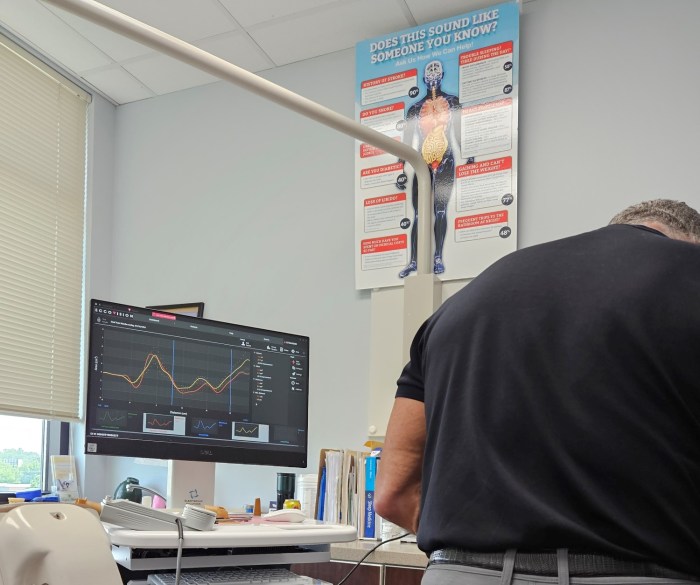
At my initial appointment, the dentist did a comprehensive exam which included examining the structures in my mouth; the palate, uvula (that little hangy-down thing in the back of your throat that keeps food from going up your nose) and tonsils; and measured the circumference of my neck. He also looked in my nose to make sure that both nasal passages were open and free of any obstructions and used an instrument to test the airflow in each nostril. He then used an intra-oral scanner to make a digital scan of my teeth for the mold for the appliance.

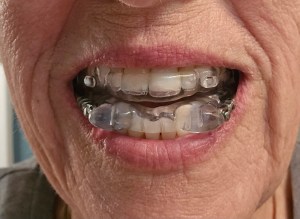
I returned three weeks later to pick up the appliance. It fits over both my upper and lower teeth and has an adjustable hinge (and being a hinged appliance is one of the requirements to be Medicare eligible.) The dentist show me how to get the appliance seated in over my teeth and then told me to bite down to secure it in place. All was well until…until it wasn’t. He told me to take it out and it wouldn’t budge. He assured me he could remove it, but…he couldn’t. He tugged and pushed and pulled and as he pulled the appliance upward with force, I mumbled through the fingers in my mouth, “I’m afraid you’re going to pull my crown off!” He assured me that he wouldn’t…until he did. He pulled up so forcefully, the appliance finally dislodged, taking the crown from my back tooth with it.
Needless to say, I was less than thrilled and although he make adjustments to the appliance–after he removed my crown from it–I was very leery of putting it back in my mouth. He assured me that he had it refitted properly and had me put it back in. This time it came out, but not as easily as I would prefer. He took it back and ground on it a little more and this time when I tried it, it did come out.
After recementing my crown, he packed up the appliance with a cleaning brush and adjustment tool and rubber bands (I guess like those used with braces), gave me instructions jaw exercises I needed to do in the mornings after removing the device, I paid my portion of the cost and out the door I went with my little box.
And now I have fear of it getting stuck in my mouth again and losing another crown or even worse, one of my old brittle root-canaled teeth breaking off at the gumline (as three have already done.) So a week later, it’s still in its box.
**An update, since this episode has remained unpublished for a week, after about five days, I got the courage to put the device in my mouth before bed, but I was careful not to bite all the way down on it. I woke up about an hour and a half later and took it out, just to make sure I could. I have now worn it carefully for a couple nights but so far, I can’t see any change. I’ll keep you informed.
 Carpediemdona.com
[…] maybe it was because I had started to be a more compliant patient and had started to wear my “Mandibular Advancement Device” again for my mild sleep apnea. (I had quit wearing it because it had caused my jaw to move […]
[…] tooth was sore. I didn’t really think much of it since I had just started wearing my “Mandibular Advancement Device” again. Incidentally, this was the same tooth that the device became stuck on the first time […]