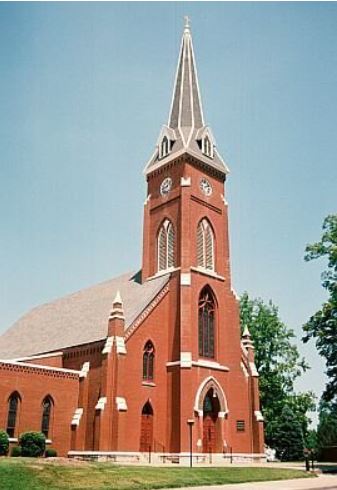
Do you ever think about the parts of a church you don’t get to see? I had been a member of Immanuel Lutheran Church in my hometown for the first thirty-plus years of my life before transferring to my current church. I spent many, many hours during my elementary education sitting in those pews (albeit staring up at the ceiling watching the wasps fly in and out of the decorative ceiling vents). I was baptized there. I was confirmed there. My first marriage took place there and I sang in the choir.

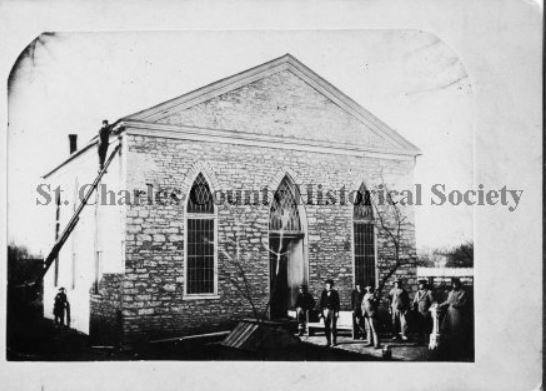
This church was built in 1867 but my family history with the Immanuel congregation goes back even farther than that. In 1848 two ancestors on my mom’s side, Henry Ehlmann (most likely Hermann Heinrich) and H. D. Ehlmann (probably Hermann Dietrich) helped to organize this new congregation when they
“severed their connection with the old stone church on the Boone’s Lick road, and, uniting with a few Lutherans who had settled in the city and below St. Charles, laid the foundation to what is now the large and flourishing Evangelical Lutheran Immanuel Congregation.
(From The History of St. Charles County)
Their new stone church was erected at the same location that the current church now stands, at the corners of Jefferson and Sixth Streets in St. Charles.
My heart has always stayed with this beautiful church and only my membership in the choir at my current church keeps me from transferring back. During the summer months when my choir doesn’t practice, I return to my old church and relish the comfort of sitting in a pew I may have sat in sixty years ago with my mom and dad by my side.

Sunday, May 6, 2018, twenty-one of the original fifty-nine confirmands from my 8th-grade class at Immanuel attended our 50th confirmation reunion. (That’s me, bottom row, second from left) Just a little over three weeks later, in the early morning hours of Tuesday, May 29, a low rumble was heard throughout the neighborhood and then a large boom. One of the ear-witnesses said the boom had woken him from sleep. He lay in his bed waiting to hear sirens he knew had to be coming to help whatever poor souls had been the victims of this loud crash. He never heard any. It was not until the next morning when one of the school workers went to the church to retrieve something, they were met with the devasting sight. The entire right side of the church’s ceiling had collapsed to the floor below.

As devastating as this ceiling collapse was, it was a blessing that it fell in the middle of the night when no one was present and it fell without damaging the beautiful altar and not one of the stained glass windows was broken.
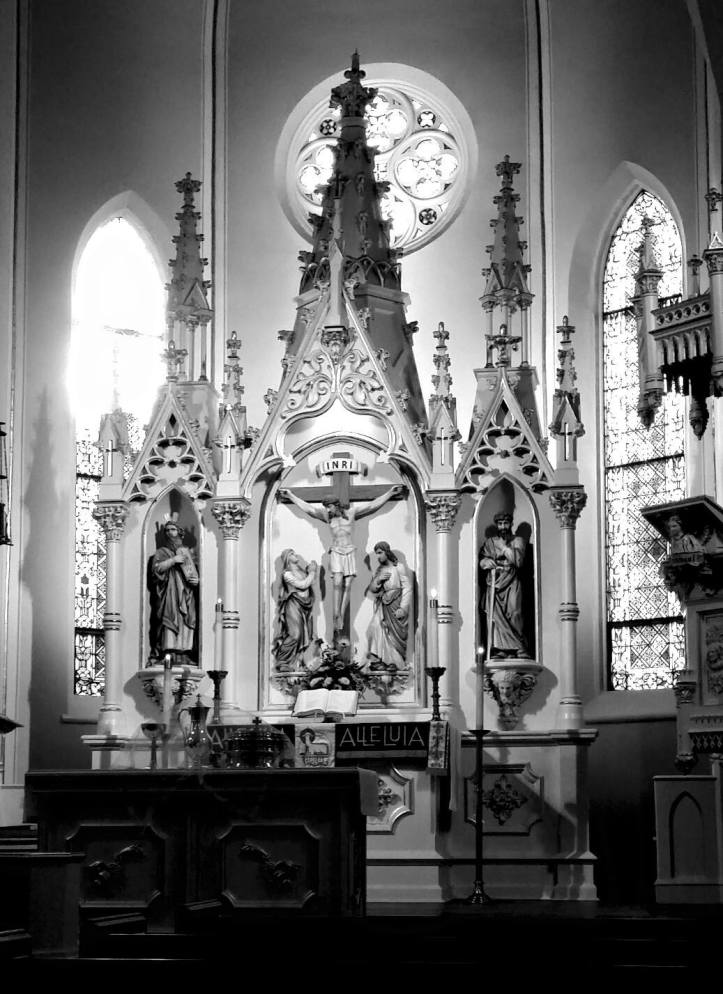
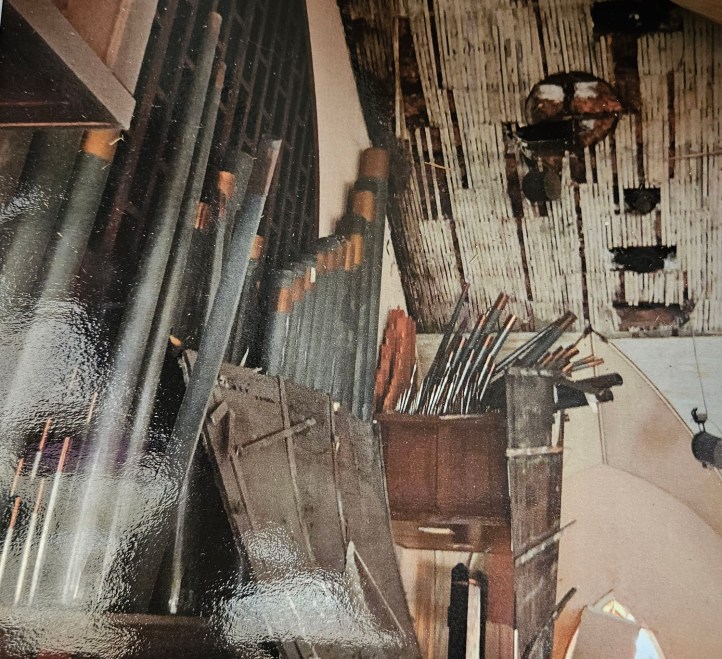
It took about a year for the ceiling restoration to be completed and the installation of the new pipes for the organ.
The other evening, the Great Hunter and I had an opportunity to tour some of those places in the church that people don’t normally get to see; the basement and the steeple.
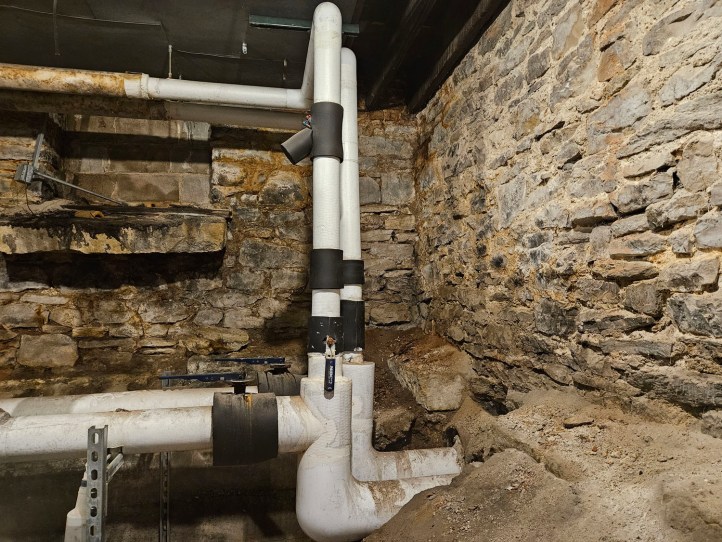
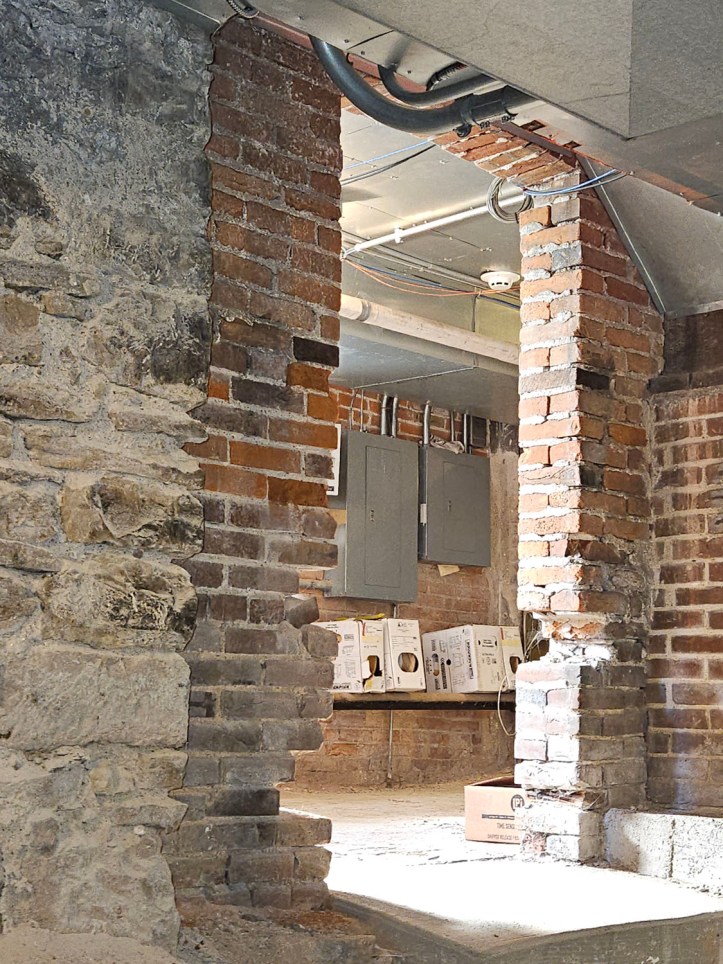
The first thing that surprised me is that I didn’t know the church had a basement. When the pastor led us to the covered exterior opening, I wondered how I had never noticed this before. The doorway led down three stairs into a much newer brick and concrete room. This room led through crumbling brick doorway to the “guts” of the basement. The stone part of the foundation is original from 1867 but the brickwork is more recent; probably only 100 years old. The basement is mostly just a crawl space that allows for the ductwork and air conditioning and heating and pipes.
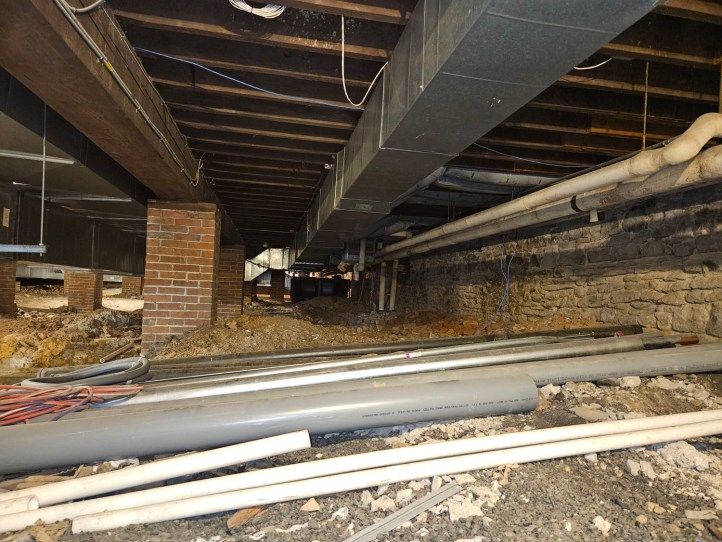
After leaving the basement, our next stop was the steeple.
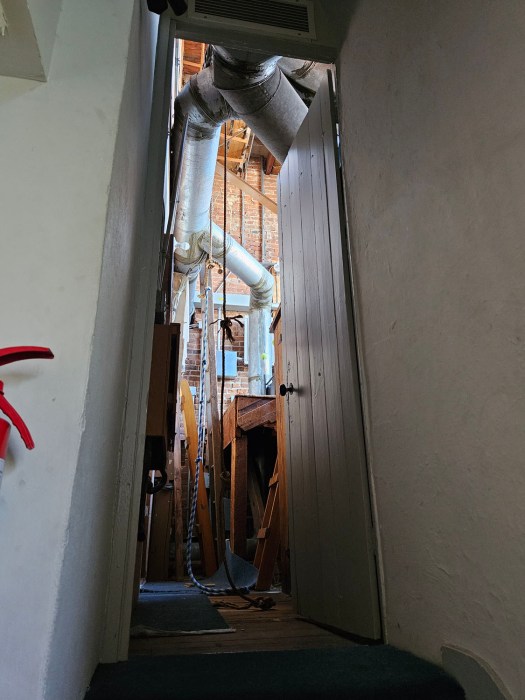
We climbed the curving stairs to the choir loft and then entered a small doorway off to the side. This doorway opened to the narrow, worn, wooden stairway to the first level in the steeple. As I walked up these stairs, I thought about all the other generations of people who had walked up these stairs.
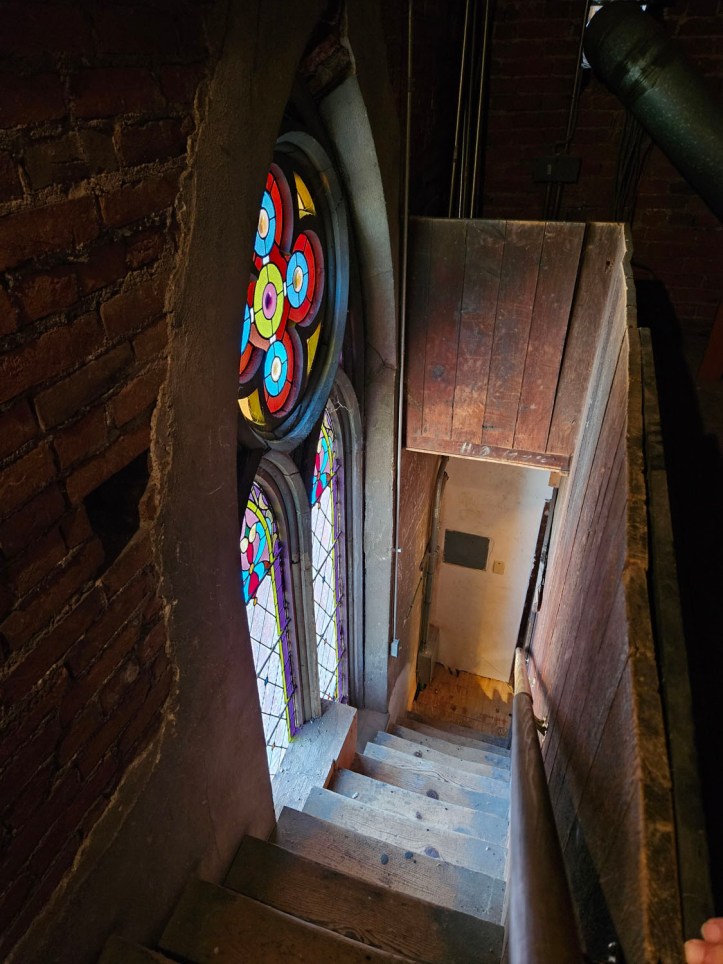
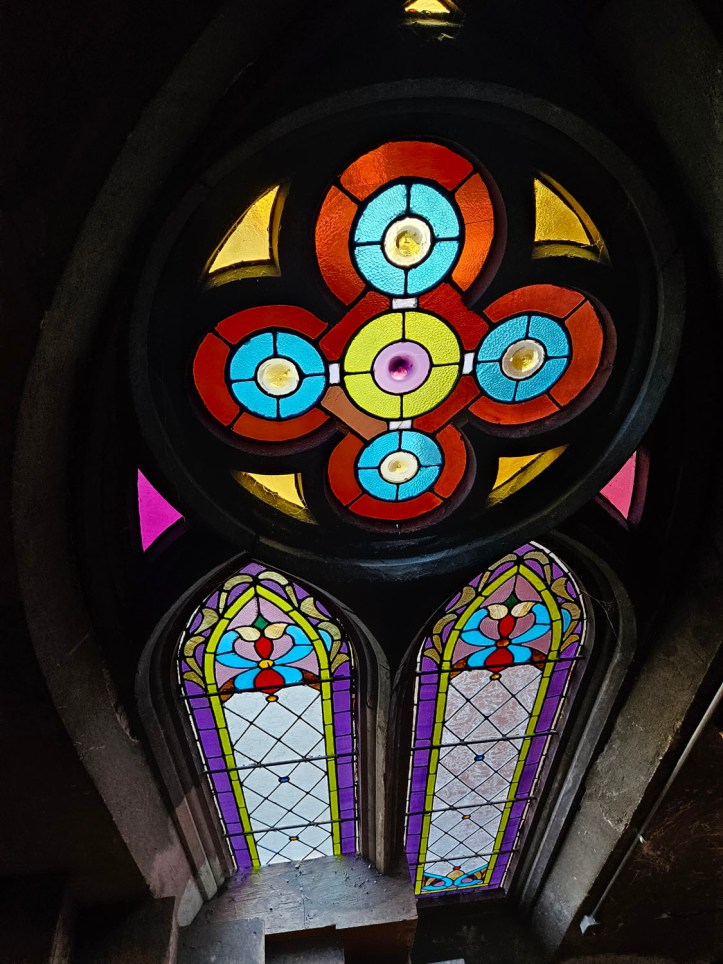
On the exterior side of this landing, light could be seen coming through the brick. The church is currently conducting a financing campaign to finance the tuckpointing for this area. One of the tour participants talked about bats that would come through the holes in the bricks and would fly around inside the church. She said during one of the performances of Boars Head (their annual Christmas presentation), one particular bat flew around so long with nowhere to alight, he was obviously getting fatigued. He was flying lower and lower and with a church full of people, that was not a good thing. The bat finally got so low that one of the ushers was able to throw a coat over top of the bat, capture it and release it outside.
A second set of narrow, steep stairs led to a second landing. The Great Hunter climbed those stairs but being not the most sure-footed person of late, I opted to stay on the first landing.

We were told there was even another level up to the top of the steeple where the three large bells are located but the committee in charge of the church did not think it was a good idea to include that level in the tour.
The tour ended on the opposite side of the choir loft where the doorway that leads to the ropes to ring the bells is located. The bells are still rung manually, the same as they were 175 years ago.
Recently Pastor Ryan Taylor of Immanuel posted a video about a sermon series they are conducting on the book of Psalms. He filmed this video in the bell tower at Immanuel and it is the first time I have ever seen what one of the bells looked like. (I think there are three bells up there.) To me, the ringing of the bells has always been magical. But me being me, I can’t just look at a photo if there are any historical clues in it, I have to go to the god of all knowledge, Google, and see what I can find. (And of course, those people behind the god of all knowledge, Google, were given this ability by the real God of all Knowledge.)
I found an interesting article on towerbells.org about the maker of this bell, H. W. Rincker of Shelby County, Illinois.

The Rincker foundry of Germany has provided bells for various carillons and chimes throughout the world.
H.W.Rincker was born in 1818, the first of eight children of Germanic bellfounder Phillip Rincker. When he came to this country in 1846, he was accompanied by his wife and three young children; another child was born to them in Chicago. ..
H.W.Rincker left Chicago in 1856, following the death of his second daughter, to attend the Lutheran seminary in Fort Wayne, Indiana. Upon his graduation in 1858, he was called to became the pastor of a Lutheran church in Terre Haute, Indiana, and was ordained to the ministry there. After occasionally preaching at churches in eastern Illinois in the early 1860s, he resigned his pastorate in Terre Haute in 1864 on grounds of ill health, and settled across the border in Illinois. But in 1865 he was called to become the first pastor of a newly-formed Lutheran church in the small town of Sigel, in Shelby County, Illinois. In 1866-67 he was “called to St.Louis,” Missouri, to make (or re-make) bells for some Lutheran churches in that area; at least nine are known to have been made then, and seven have survived to this day. ..
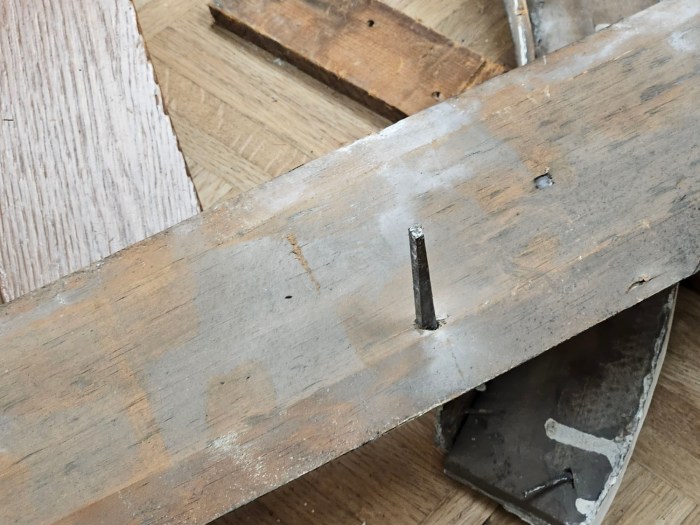
After the tour, we gathered in the atrium to view a display of some of the debris saved from the collapse. Pastor Schmeding, who had conducted the tour, stated it was later determined that the wood that ran the length of the ceiling at the apex of the two sides, had pulled away causing the collapse.
So now that I know what’s beneath the church, the next time I’m sitting at Boars Head and the King’s men come stomping down the aisle pounding their staffs on the floor, if the floor were to collapse, I won’t have far to fall. That’s a comforting thought. 😄
The Great Hunter and I ended our evening with a stroll on historic Main Street and dinner at a restaurant in a converted First National Bank building. Being one of our first excursions in a long time, it was a very good night.

Click on the link below for a more detailed story on the collapse.
‘Christ’s Church is not a building’: Immanuel, St. Charles, looks ahead after ceiling collapse
 Carpediemdona.com